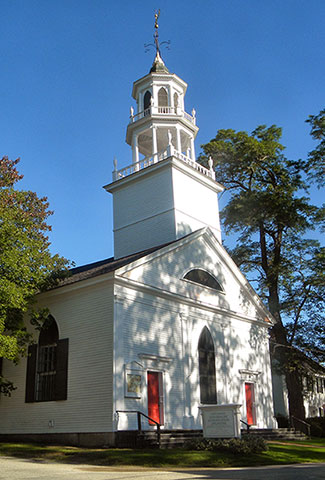

Why Agnostics Go To Church
READING: from Stephen Batchelor, Buddhism Without Beliefs, Riverhead Books,
New York, 1997:
For T. H. Huxley, who coined the term in 1869, agnosticism was as demanding as any moral, philosophical, or religious creed. Rather than a creed, though, he saw it as a method realized through “the rigorous application of a single principle.” He expressed this principle positively as: “Follow your reason as far as it will take you,” and negatively as: “Do not pretend that conclusions are certain which are not demonstrated or demonstrable.” This principle runs through the Western tradition: from Socrates, via the Reformation and the Enlightenment, to the axioms of modern science. Huxley called it “the agnostic faith.”
READING: from Ralph N. Helverson (d. 2007), Living in the Questions, Lindsay Press,
London, 1977:
The capacity to be uncertain – and not be too unhappy about it – is a gift of
the spirit. The extent to which people are free is their capacity to rest in
uncertainty. For freedom is not an end, but the means to an end that is not
always visible. Freedom is not an answer but the means to find answers.
SERMON
Why do agnostics come to church? Is it because we advertized
this sermon title in an email announcement? I suspect not.
Let’s start by defining what we mean by “agnostic.” Thomas
Henry Huxley, famous as “Darwin’s bulldog” – the defender of Charles
Darwin’s theory of evolution – coined the term in the 19th century.
Agnosticism is the view that certain claims, especially about the
existence of a God or divine being, are unprovable or even unknowable.
At one time I thought atheists were overconfident agnostics, and
agnostics were wishy-washy atheists! But today I think the atheist and
the agnostic are simply answering different questions. To the question,
“Does God exist?”, the agnostic says, “It’s impossible to know for
certain.” And to the question “Do you believe God exists?”, the atheist
says, “No, I don’t believe God exists.” Two different questions, two
different answers; it depends on whether the question is about what we
believe, or whether the question is about what can be known with
certainty.
And there are also some who might agree with a bumper sticker
I’ve seen: “Militant Agnostic: I don’t know – and you don’t either!”
And again, there’s something called ignosticism that says that the
concept of God is meaningless. This term was coined by a Jewish rabbi,
Sherwin Wine (1928-2007). The ignostic says, “Before we could even
discuss whether or not there’s a God, we would have to have a coherent
definition of God. Since there is no agreed-upon definition of God, and
even theists say that God cannot be adequately defined, we can’t have a
meaningful discussion about whether or not God exists.”
What, in fact, do we mean by “God”? Is it someone who walked
in the Garden of Eden in the cool of the evening, talking with Adam and
Eve? Is it the Christian Trinity of three-gods-in-one? Is it the Ground of
Being as theologian Paul Tillich said, or the Creative Process of the
Cosmos as process theologians have said? My definition of God may
not be your definition.
Rabbi Wine’s synagogue in Farmington Hills, Michigan, is based
on Jewish heritage and Jewish ethics, not belief in a supernatural being.
He said, “The message of the Holocaust is that there isn’t any magic
power.”
And as Rabbi Wine’s Humanistic Judaism demonstrates, even
though agnostics admit that they really don’t know whether or not there
is a divine being, many do attend churches, synagogues, or even
mosques. Why? There are, in fact, many reasons why a person who has
doubts the existence of God would go to church.
Church-going agnostics ~
First of all, some agnostics hope to find sacredness in our world,
even though they admit that the concept can neither be proved nor
disproved. Early in the twentieth century, Unitarian minister John
Haynes Holmes said, “When I speak of God it is poetry and not
theology.” He experienced the holy, or the presence of the divine, not in
any doctrinal approach, but through his experience of nature, in
community with fellow humans, in the words of the poets, and in the
presence of justice, peace, loving-kindness and compassion.
So some agnostics come to church, not in any kind of certainty,
but in the hope that we can find something here, in community with
others, that will nurture the spirit.
And second, there are people who attend church not so much for
themselves – at least not at first – but for their children. They want their
children to learn about Christianity and Judaism and other world
religions so that they won’t grow up religiously illiterate; and to be
taught cooperation, kindness, and other ethical ideas. They look for a
congregation like ours because they want their children to gain this
religious exploration in a place where their heads won’t be filled with
guilt, shame or fear. They want their children educated in a place that
lets children use their curiosity and ask questions.
But couldn’t you let a child’s religious education simply blossom
on its own accord? There is a story, I recall, about the poet Samuel
Taylor Coleridge. Someone, visiting Coleridge, expressed the opinion
that he did not believe in giving his children any religious education. He
said, “I don’t want to impose any ideas on them. I prefer to let them
develop in their own way.” Coleridge seemed to change the subject
saying, “Would you like to see my garden?” His visitor agreed that,
indeed, he would enjoy seeing the garden. But when taken outside the
visitor was unable to see anything resembling a flower garden. “This is
simply a mess of weeds,” said the visitor. “Oh, I don’t want to impose
my ideas on it,” Coleridge said, “I prefer to let it develop in its own
way.”
I contend that religion is like sex. Like sex education, if you
don’t teach your children about religion they will still hear about it from
the other kids, and they are likely to learn all of the wrong lessons. And
so the focus of a Unitarian Universalist Sunday school, a Religious
Exploration program, is to help spark children’s curiosity. We want
them to learn about the big questions, and how people in many cultures
have answered these questions. We want them to gain basic decision-
making skills so that they have a solid basis for answering questions
they will face as they grow older. In other words, a UU Sunday School
isn’t about indoctrination; it’s about exploration and growth.
So some parents go to church for their children, but end up
staying for themselves. Because religion, as we practice it here, is
inclusive, free, and we hope, intellectually honest. This is a church
where you can bring your questions and your doubts, and not feel like a
hypocrite, reciting doctrinal statements that no longer make sense.
The fruit of the tree ~
Why might agnostics go to church? Because we all have
questions of meaning that we wrestle with; because we all experience
anxiety and encounter loss; because we all need forgiveness sometimes;
because we all need to celebrate sometimes; because we seek beauty,
and long for community.
Rev. Marlin Lavanhar of All Souls Unitarian Church, Tulsa, OK,
explains our approach to religion by recalling the story of Adam and
Eve. According to the book of Genesis, God said to Adam and Eve that
they could eat the fruit from all the trees in the Garden of Eden except
from “the tree of knowledge of good and evil.”
Even as a child in Methodist Sunday school I was disturbed that
they weren’t allowed to eat from the tree of the knowledge of good and
evil. It seemed to me, even when I was 12 or so, that knowing the
difference between good and evil would be a good thing. Today I
understand the Garden of Eden story to be a myth or parable. It was
never a story about biology or astronomy or the geological age of the
earth. So now, understanding that Eden is a parable, I don’t see “the
tree of knowledge” to be a threat.
Yet in our tradition, Rev. Lavanhar says that there is one tree that
is forbidden, and here the name of that tree is “exclusion.” That is, if
someone starts to believe that they know for certain who is good and
who is evil, who is in and who is out, what doctrine is absolutely true or
absolutely false, we have a problem. We can eat from the trees of
knowledge and tradition and religion and spirituality and sociology and
philosophy and science, but NOT from that tree that – once we eat from
it – causes us to be self-righteous and believing that all the other trees
are wrong or heretical or inferior. Because, Lavanhar says, eating the
fruit of the tree of exclusion leads to death; death in the sense that
exclusive beliefs kill community. The fruit of the tree of exclusion cuts
us off from other people, other ideas and other truths.
The fruit of the tree of exclusion led to the Crusades, the
Inquisition, and the Holocaust. The tree of exclusion led to racial
segregation in America, genocide in Rwanda, the gay-bashing murders
of Charlie Howard and Matthew Shepard, the 911 terrorist attacks, and
the current war in Gaza.
Many people think they have the truth, but in fact they are
worshiping a very small god. I had some missionaries come to my door,
two very earnest young men. After some conversation I noticed that
they were always using male language to describe their god. I asked
them if their God was exclusively male. They said that yes, it was
important to them that God is male. I suggested to them that any “god”
that can be locked in a male body, unable to get out, unable to transcend
the categories of male and female, is a very weak and small god.
Too many people worship a small god, a god that teaches male
superiority, racism, anti-gay prejudice, or the superiority of one narrow
religious outlook. But here’s the danger for us. We can become self-
righteous, too. Sometimes we get to that exclusive place, where we
think that others are mired in mindless superstition. We need to be
careful to not slip into our own kind of dogmatism.
The agnostic method ~
John Stuart Mill, in his classic book On Liberty, said that it is
unlikely that any idea is ever perfectly true. Even if you are mostly
right, you may be partly wrong. The other person may be mostly wrong,
but could be partly right. And so when others have the freedom to
express their ideas, you may learn something you might otherwise have
overlooked. And in the unlikely event that others are completely wrong,
and you are completely right, you still will have refined your own ideas
by listening to theirs. When we are willing to entertain uncertainty we
are on the path to greater truth.
And so I appreciate what the Buddha once said, “Do not be
satisfied with hearsay or with tradition or with legendary lore or what
has come down in scriptures… or with the thought, ‘the monk is our
teacher.’” Instead, the Buddha said, you should look to the lives of those
who are following the path, and see for yourselves if it is working for
them. Better still, you should try the Buddhist path for yourself. If it
works in your own life, if it leads to greater contentment and happiness,
then the path is worthwhile.
I’ve benefitted tremendously from participating in a Buddhist
meditation and discussion group here in Ellsworth. And at the same
time, I’ve also benefitted from the path taught by the rabbi Jesus of
Nazareth – love your neighbor, be a peacemaker, feed the hungry, give
drink to the thirsty, comfort the sick, welcome the stranger.
Of course, Jesus cannot be divorced from his faith, his ultimate
trust, in God. I concur with Rabbi Sherwin Wine that there is no
agreed-upon definition of God, and I am still searching for a definition
that works for me. I like Mary Daley’s insistence that we move
“Beyond God the Father” to a God that transcends sexual categories. I
like Spinoza’s thesis that equates God with Nature, and Nature with
God. I like John Haynes Holmes’suggestion that the word “God” is
poetry and not theology. And, perhaps most of all, I like the Biblical
statement that “God is Love.” (1 John 4:8).
My definition of God, then, is very different than the Nicene
Creed’s definition, and almost certainly different from Rev. Franklin
Graham’s. Mine may be an agnostic’s definition. It’s certainly not the
“Old Man In the Sky,” at any rate. And if we were to call it “the Inner
Light” as Quakers do, or “the Buddha-spirit,” I’m fine with that, too. So
I’m perfectly comfortable as a Buddhist-Christian-Agnostic. I don’t
have to know for certain.
Why, then, do agnostics come to church? We don’t expect to
agree on doctrine. We come to church to grow spiritually, to live
ethically, support one another in our joys and sorrows, nurture
community, appreciate beauty, increase our own hope and happiness and
that of others, work for a more just society, to express our gratitude for
all that we have, to love this world, and pass on our values to future
generations. That, for me, is enough.
Amen.
