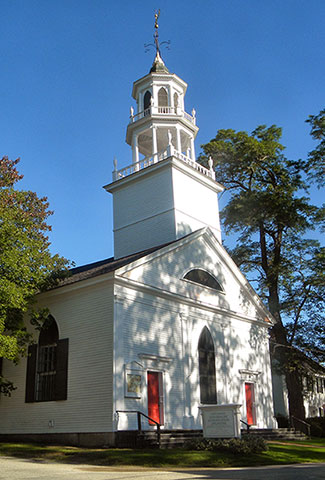

About our congregation

Unitarian Universalism affirms that life is too grand, complex and mysterious to be captured in a narrow creed. That is why we cherish individual freedom of belief. At the same time, we affirm that the blessings of life are available to everyone, not just to the “chosen” or the “saved.” We affirm that the earth and all its creatures, the stars in all their glory, are holy; that the Sacred or the Holy is made evident, not in the supernatural, but in the simple and everyday; that human beings, enriched by the grace of the world, are responsible for the planet and its future; that every one of us is part of the interdependent cosmic web, and hence strangers need not be enemies; that “salvation” means building a better world for all; and that the paradox of life is to love it all the more even though we ultimately lose it.

Our congregation

Founded in 1790 as the “First Congregational Society” of Castine, our first minister, the Rev. William Mason, was a liberal Christian who led the congregation into the ranks of Unitarianism. While we remain respectful of our Christian heritage, our free church tradition allows for a wide range of personal beliefs that include religious ideas drawn from many sources. Our covenant reads, “Love is the spirit of this congregation, and service is its law. This is our great covenant: To dwell together in peace, to seek the truth in love, and to help one another.”

We are a community at the Unitarian Universalist Congregation of Castine. Together we are on our spiritual journeys, and we welcome you to join us!

“We need not think alike to love alike” - Francis David (1510-1579)

Learn more about Unitarian Universalism at http://www.uua.org/


Unitarian

Unitarianism has historically emphasized the unity of God, the humanity of Jesus, the ability of individuals to choose good over evil, the importance of personal character, the use of reason and conscience, and the independence of each local congregation.

For three hundred years after the time of Jesus, there were many competing ideas about Jesus.. Some early Christians thought Jesus was a human teacher; some thought he was God; others (like the priest Arius) thought he was more than a man but less than God.

Read more

Universalism

The defining teaching of the Universalist Church in America was Universalism, or "universal salvation," the doctrine that a loving God would not create a torture chamber called "Hell," and then create people so flawed that they had to be sent there. Since the Bible tells us that "God is love" (1 John 4:8 and 4:16), the Universalists had faith that all people would be saved, and none would be damned forever.

Some Universalists, the "Restorationists," thought there might be a temporary punishment for some very wicked people, but that eventually all people would be restored to a proper relationship with God.

Read more